Teléfono Emergencias 24/7
975 225 980
Lunes, martes, miércoles y jueves: de 9:00 a 20:00 - Viernes: de 9:00 a 15:00

Pregúntanos por los sábados que trabajamos

Everything you need to know about root canal treatmentRoot Canal Treatment

We carry out painless, quality and meticulous root canal treatments, applying the best materials, insulation and digital reconstruction techniques.
Endodoncia Clínica Dental Aitziber Yagüe Soria
Clínica Dental y Maxilofacial Aitziber Yagüe Cortázar Soria
bt_bb_section_bottom_section_coverage_image

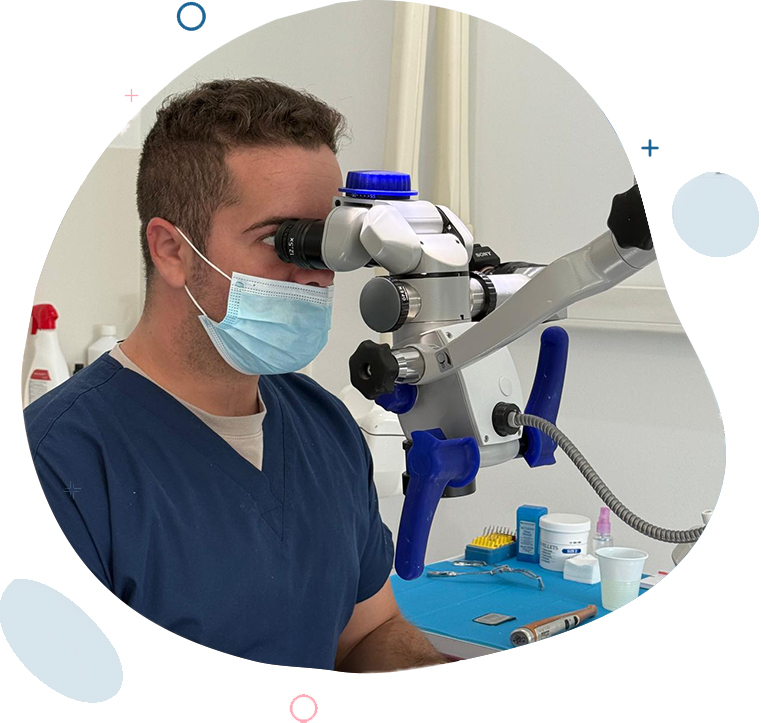
Our endodontist

• Bachelor’s degree in Dentistry from the International University of Catalonia (2019)
• Master’s degree in Advanced Endodontics from the European University of Madrid (2021)
• Course on Retreatment, Instrument Removal and
complex endodontic cases at EndoSevilla Academy (2022)
• Dedicated endodontist for over six years.
https://aitziberyaguecortazar.com/wp-content/uploads/2025/12/tratamiento-de-endodoncia-soria-endodoncista.jpeg

What is a root canal treatment and when is it necessary?

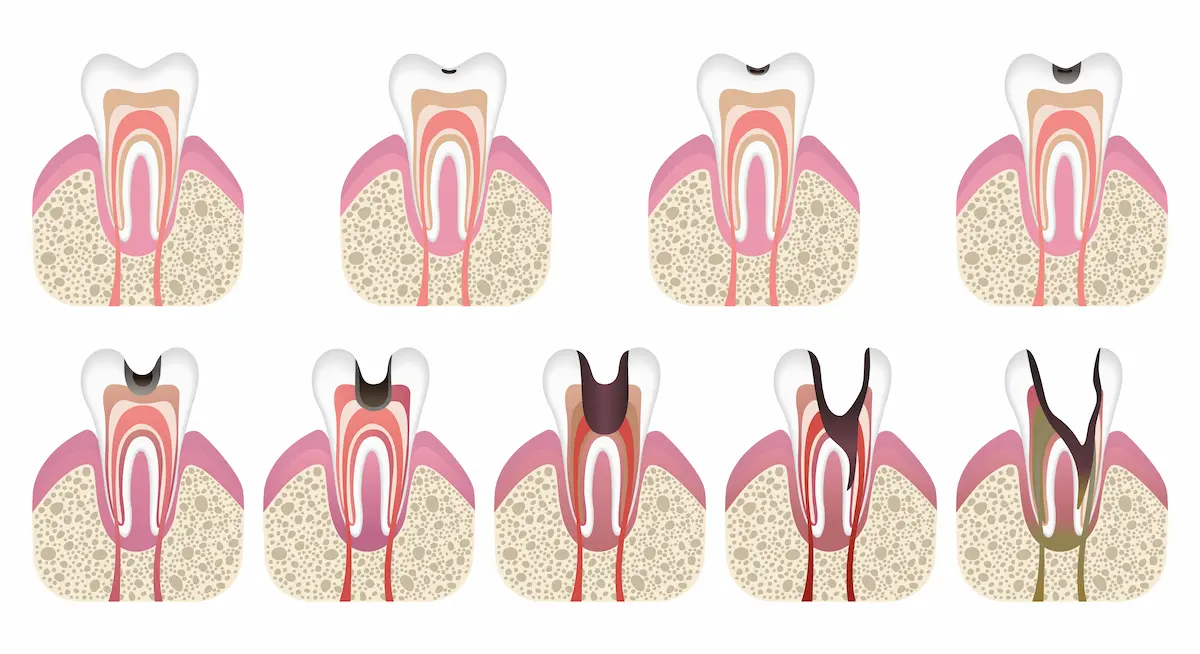
Endodontics, commonly known as ‘root canal treatment’, is a dental procedure designed to save teeth with damage to the dental pulp, the inner part of the tooth that contains nerves and blood vessels.
This treatment allows you to preserve your natural tooth and avoid unnecessary extractions, whilst maintaining the chewing function and aesthetics of your smile.
It is recommended when there is:

• Severe pain or prolonged sensitivity to cold, heat or when biting.
• Deep cavities affecting the dental pulp.
• Dental trauma such as knocks or fractures.
• Infections or abscesses in the root of the tooth.
• Changes in tooth colour indicating pulp damage.
https://aitziberyaguecortazar.com/wp-content/uploads/2025/10/tratamiento-de-endodoncia-soria-2.jpeg
https://aitziberyaguecortazar.com/wp-content/uploads/2020/04/floater-2.png
bt_bb_section_top_section_coverage_image
bt_bb_section_bottom_section_coverage_image

The main challenge in root canal treatment

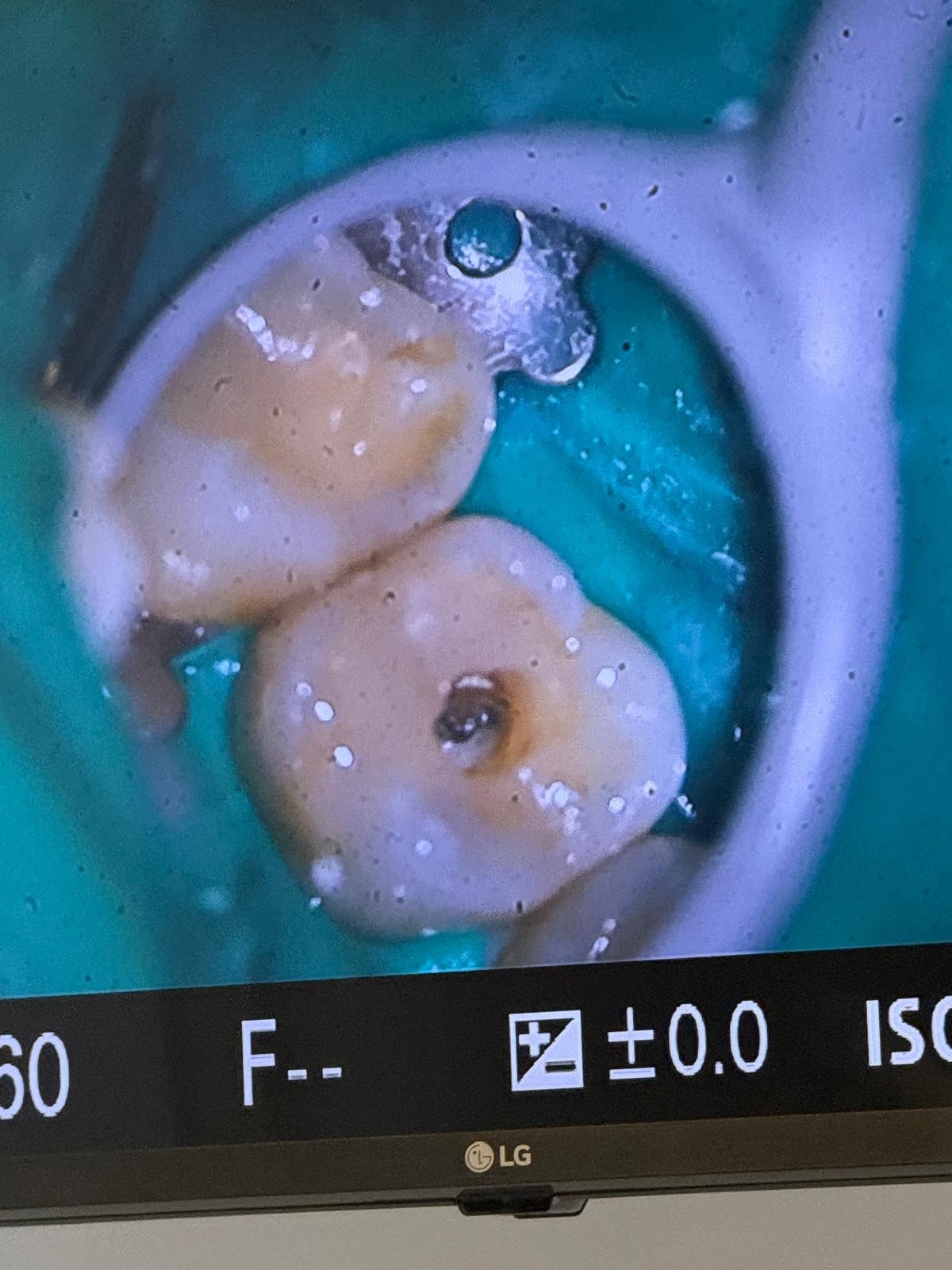
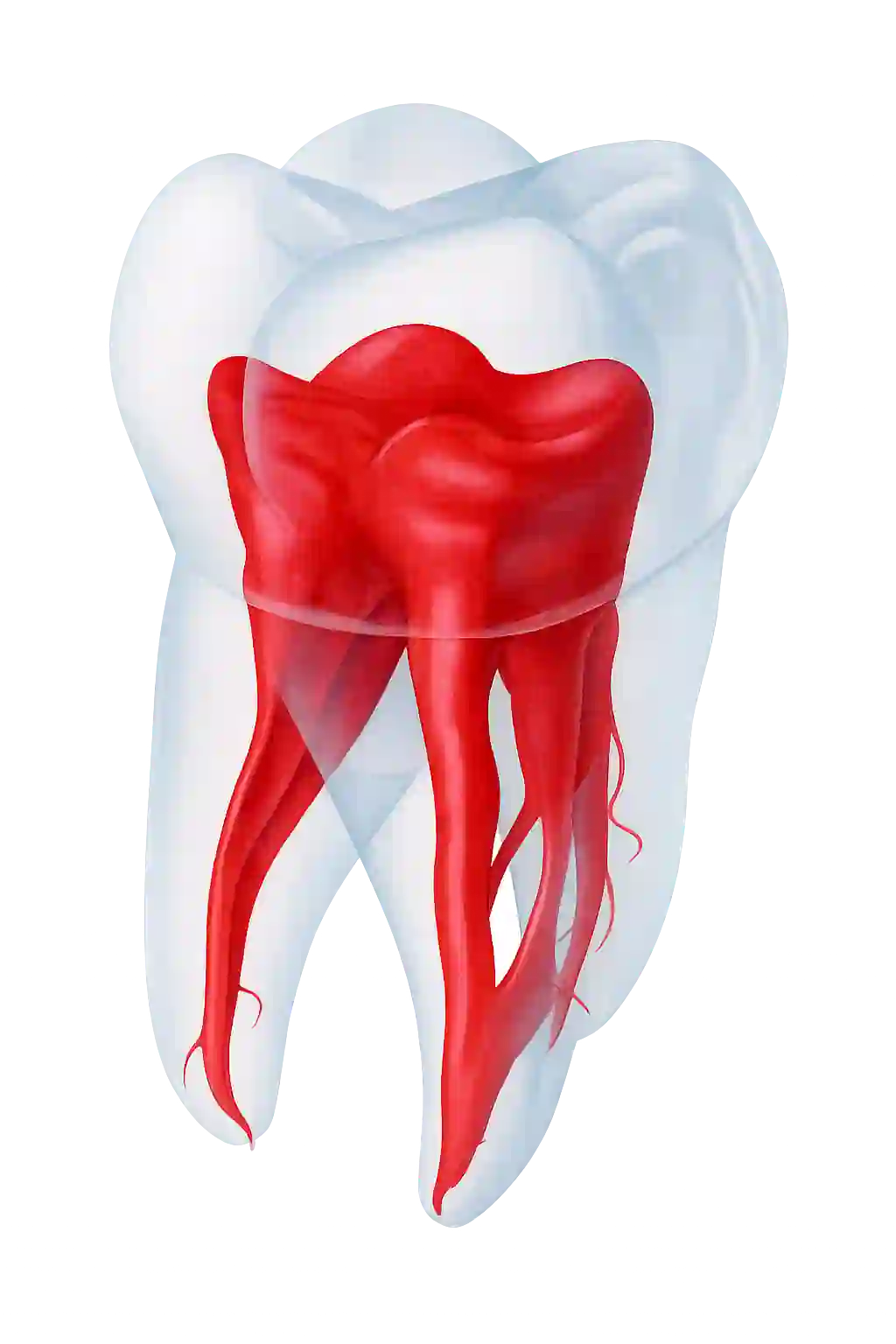
Working inside a tooth is one of the greatest challenges for an endodontist. The procedure is carried out in an extremely confined space that is difficult to access, where every micron counts. Inside each tooth there are one or more root canals — depending on the type of tooth — and these are so fine and complex that locating them is practically impossible without advanced magnification technology.

For this reason, the clinical microscope has become an indispensable tool in modern endodontics. Its high magnification and coaxial illumination enable the identification of additional canals, anatomical variations or curvatures that cannot be detected with the naked eye or using conventional loupes. Numerous studies have shown that the lack of adequate visualisation is one of the most common causes of endodontic failure, particularly when accessory or very narrow canals go unnoticed.

It is very important to use the microscope in conjunction with specific professional training, as this enables these anatomical complexities to be addressed with precision, improves the disinfection of the root canal system and significantly increases the chances of treatment success. Without this technology, many of these details would remain beyond the scope of visual observation.
https://aitziberyaguecortazar.com/wp-content/uploads/2025/12/diente-endodoncia.webp

Fully personalised treatmentsThe importance of using cutting-edge technology

In addition to the routine use of the Zeis dental microscope, our clinic is equipped with state-of-the-art technology to ensure precise and predictable results in endodontics. We have a high-resolution CBCT (Morita) for detailed three-dimensional diagnosis, which is particularly useful in root canal treatments and complex cases.
During treatment, we use a apical locator to accurately determine the length of the root canal, rotary instruments for safer and more effective preparation, and an advanced disinfection protocol supported by the Biolase laser, which enables the elimination of bacteria in hard-to-reach areas.
Finally, thermoplastic or three-dimensional filling completely and permanently seals the root canal system.

Types of root canal treatment depending on the tooth’s roots

Single-root root canal treatment

Los dientes frontales, como incisivos, caninos y
premolares inferiores, generalmente tienen una
sola raíz y un conducto radicular. Esto hace que
el tratamiento sea más sencillo y rápido, con excelentes tasas de éxito.

Two-root root canal treatment

The upper premolars and some lower premolars,
as well as the lower incisors, generally have two roots, each with one or more root canals. They require careful cleaning and disinfection of all the root canals to prevent future infections

Multi-root root canal treatment

Molars are multi-rooted teeth with three or more roots, each containing multiple complex root canals. This type of root canal treatment requires advanced techniques, specialised instruments and, often, the use of a
dental microscope to ensure that all root canals are correctly located, cleaned and sealed.
At our clinic, every root canal treatment is tailored to the condition of the tooth and the number of roots it has.
We use state-of-the-art technology, including a Zeiss dental microscope, in all treatments of this type, to ensure thorough cleaning.
etapas-de-la-endodoncia

CBCTThree-dimensional radiological techniques

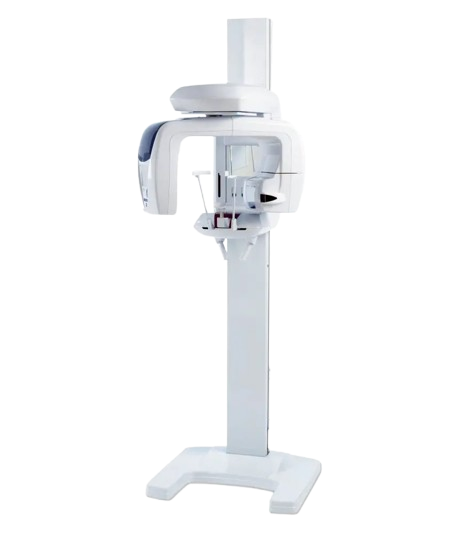
The Morita CBCT that we use in our clinic is an essential tool in advanced endodontics. Its ability to generate very high-resolution three-dimensional images allows us to visualise with complete clarity the internal anatomy of the tooth and all the details of the root canal system.

Thanks to its accuracy, the Morita CBCT reveals critical information for endodontics:
Additional canals that do not appear on conventional X-rays.
Pronounced curvatures or extremely fine canals.
Calcifications, resorption or internal abnormalities.
Periapical lesions requiring an accurate diagnosis.
• Complex situations such as retreatment, where it is essential to locate the source of the problem.

This equipment stands out for providing clear and reliable images with a very low radiation dose, enabling us to work with safety and confidence even in anatomically challenging cases.

In endodontics, having a real 3D view is essential for planning access, avoiding perforations, assessing the extent of lesions and selecting the most appropriate treatment in each case. For this reason, the Morita CBCT is our method of choice for complex diagnoses and a key tool for achieving more precise, conservative and predictable treatments.

https://aitziberyaguecortazar.com/wp-content/uploads/2025/12/Morita-Veraviewepocs-3D-R100-removebg-preview.png
https://aitziberyaguecortazar.com/wp-content/uploads/2020/04/floater-2.png
bt_bb_section_top_section_coverage_image
bt_bb_section_bottom_section_coverage_image

Zeiss microscope

The dental microscope we use is state-of-the-art and features Super LED lighting, which allows us to work with extraordinary precision. Its optical system achieves a magnification of up to 26x, multiplying the human eye’s visual capacity and revealing details that would be impossible to detect without this technology.

The coaxial Super LED lighting is projected precisely onto the point we are observing, literally penetrating the interior of the tooth. This ensures perfect visibility throughout the entire procedure, even in deep, narrow or curved areas. Furthermore, the microscope incorporates optical filters that optimise contrast and allow for clearer distinction of internal tissues and structures.

At our clinic, the microscope is used at every stage of endodontic treatment: from access to the root canals through to cleaning, disinfection and final preparation. This enables us to be more conservative, to work with maximum precision and to ensure the best possible foundation for the relevant specialist to subsequently carry out the final reconstruction or restoration of the tooth.
https://aitziberyaguecortazar.com/wp-content/uploads/2025/12/localizador-de-apices-endodoncia-soria.webp

Apex Locators

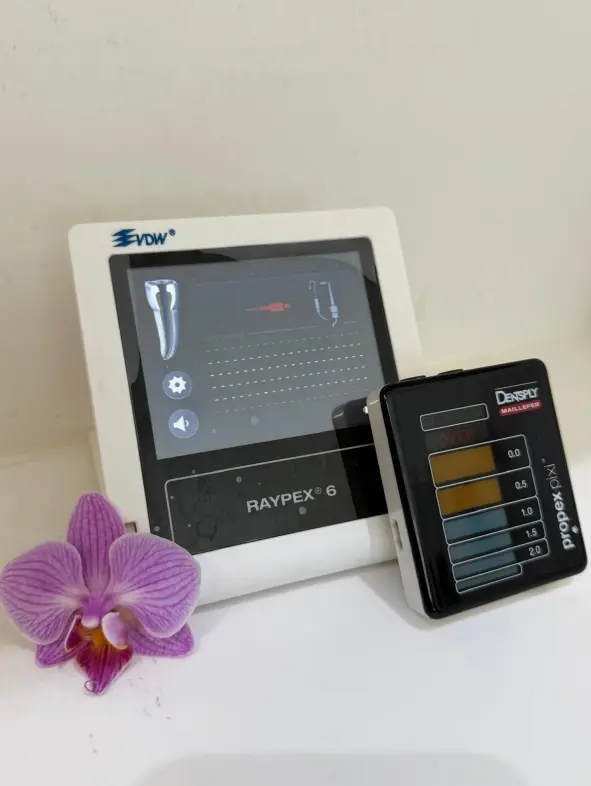
The apical locator is essential in our root canal treatments, as it enables us to determine precisely the exact length of the root canal. Thanks to this electronic measurement, we work within the correct anatomical limits, avoiding going beyond the apex (which can lead to a poorer post-operative outcome) or falling short and leaving pulp tissue uncleaned, thereby ensuring an optimal seal.

Its use is particularly beneficial in curved canals, narrow canals or in retreatment cases, where the radiographic reference may not be sufficient. With this technology, we achieve a safer, more precise and more predictable root canal treatment.

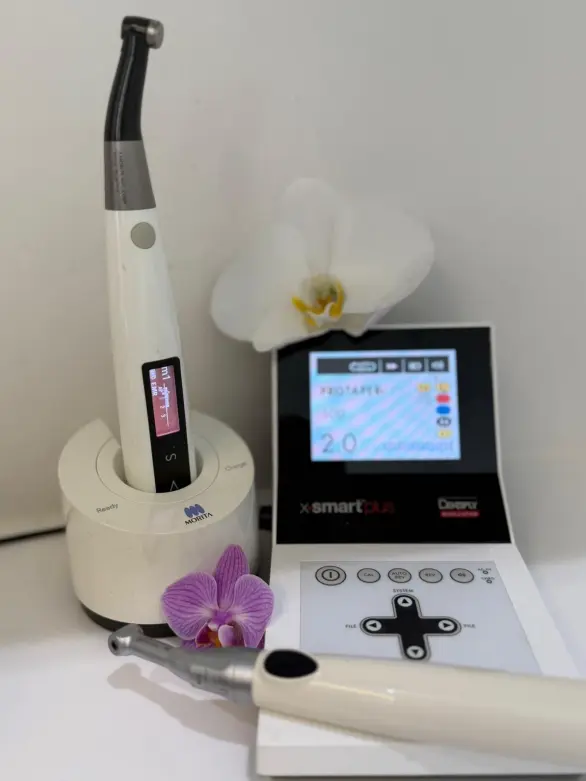
Rotary instrumentation

Another of the technological advances we have at our disposal is the Biolase laser, a tool that enables us to decontaminate and sterilise the root canal system much more effectively. Scientific evidence shows that one of the fundamental long-term pillars of root canal treatment is the complete elimination of the bacterial load, and the laser offers superior capability in this process.

Our state-of-the-art laser, used in conjunction with traditional chemical solutions with germicidal properties, successfully eliminates bacteria both within the root canals and in the surrounding periapical tissue. This translates into higher success rates and safer, more predictable treatments.

Furthermore, this technology is suitable for all types of patients and contributes to more thorough disinfection, minimising risks and improving the final prognosis for the treated tooth.
https://aitziberyaguecortazar.com/wp-content/uploads/2025/12/instrumentacion-rotatoria.webp
https://aitziberyaguecortazar.com/wp-content/uploads/2025/12/laser-biolase.webp

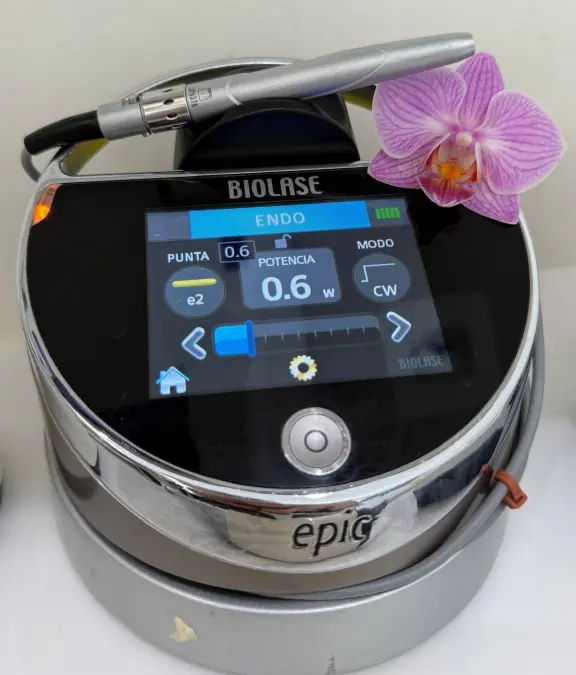
Biolase Laser

Another of the technological advances we have at our disposal is the Biolase laser, a tool that enables us to decontaminate and sterilise the root canal system much more effectively. Scientific evidence shows that one of the fundamental long-term pillars of root canal treatment is the complete elimination of the bacterial load, and the laser offers superior capability in this process.

Our state-of-the-art laser, used in conjunction with traditional chemical solutions with germicidal properties, successfully eliminates bacteria both within the root canals and in the surrounding periapical tissue. This translates into higher success rates and safer, more predictable treatments.

Furthermore, this technology is suitable for all types of patients and contributes to more thorough disinfection, minimising risks and improving the final prognosis for the treated tooth.

Thermoplastic or three-dimensional filling

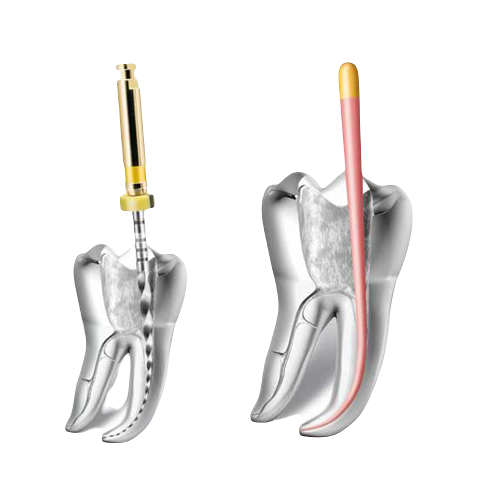
Thermoplastic or three-dimensional filling is an advanced technique that allows the root canal system to be completely sealed, even in the narrowest or hardest-to-reach areas. Thanks to this precise and uniform sealing, the entry of bacteria is prevented and the long-term success of the treatment is ensured.

This technique, combined with the rest of our cutting-edge technology, guarantees a safer, more effective and more predictable root canal treatment.
https://aitziberyaguecortazar.com/wp-content/uploads/2025/12/La-obturacion-termoplastica-o-tridimensional.webp

What is a double a root canal retreatment?

The Morita CBCT that we use in our clinic is an essential tool in advanced endodontics. Its ability to generate very high-resolution three-dimensional images allows us to visualise with complete clarity the internal anatomy of the tooth and all the details of the root canal system.

Thanks to its accuracy, the Morita CBCT reveals critical information for endodontics:
Additional canals that do not appear on conventional X-rays.
Pronounced curvatures or extremely fine canals.
Calcifications, resorption or internal abnormalities.
Periapical lesions requiring an accurate diagnosis.
• Complex situations such as retreatment, where it is essential to locate the source of the problem.

This equipment stands out for providing clear and reliable images with a very low radiation dose, allowing us to work with safety and confidence even in anatomically challenging cases.

In endodontics, having a real 3D view is essential for planning access, avoiding perforations, assessing the extent of lesions and selecting the most appropriate treatment in each case. For this reason, the Morita CBCT is our method of choice for complex diagnoses and a key tool for achieving more precise, conservative and predictable treatments.
https://aitziberyaguecortazar.com/wp-content/uploads/2025/12/placa-endodoncia.webp
https://aitziberyaguecortazar.com/wp-content/uploads/2020/04/floater-2.png
bt_bb_section_top_section_coverage_image
bt_bb_section_bottom_section_coverage_image

Aftercare following root canal treatment

Wait until the anaesthetic has worn off; avoid biting your lips or tongue.
Try not to chew on the affected side or eat hard foods or chewing gum until the permanent filling has been fitted, to protect the tooth from possible fractures.
Maintain good oral hygiene and take care when flossing, so as not to dislodge the temporary filling or restoration, if applicable.
Take any medication as directed by your dentist, as you may experience some sensitivity, discomfort, pain and/or possible swelling in the days following the procedure.
Attend your regular check-ups to monitor your progress and assess any further treatments (reconstruction, in-office whitening, veneers, etc.) that may be required over time.

Root canal treatment: what you need to know

In some cases, a tooth that has been properly restored and treated with root canal therapy may:
• Sustain a fracture due to loss of the restoration, tooth decay or other factors.
• Fail to completely eliminate the source of infection, the cystic or granulomatous process, in which case periapical surgery would be necessary.
If the tooth has an internal crack that is not visible on an X-ray, this will not be resolved by root canal treatment; and the treatment of choice will be extraction.
Centro Deontológico Estético y Maxilofacial SL ha sido beneficiaria del Fondo Europeo de Desarrollo Regional cuyo objetivo es mejorar la competitividad de las Pymes y gracias al cual ha puesto en marcha un Plan de Marketing Digital Internacional con el objetivo de mejorar su posicionamiento online en mercados exteriores durante el año 2020. Para ello ha contado con el apoyo del Programa Xpande Digital de la Cámara de Comercio de Soria.
“Una manera de hacer Europa”
bt_bb_section_top_section_coverage_image